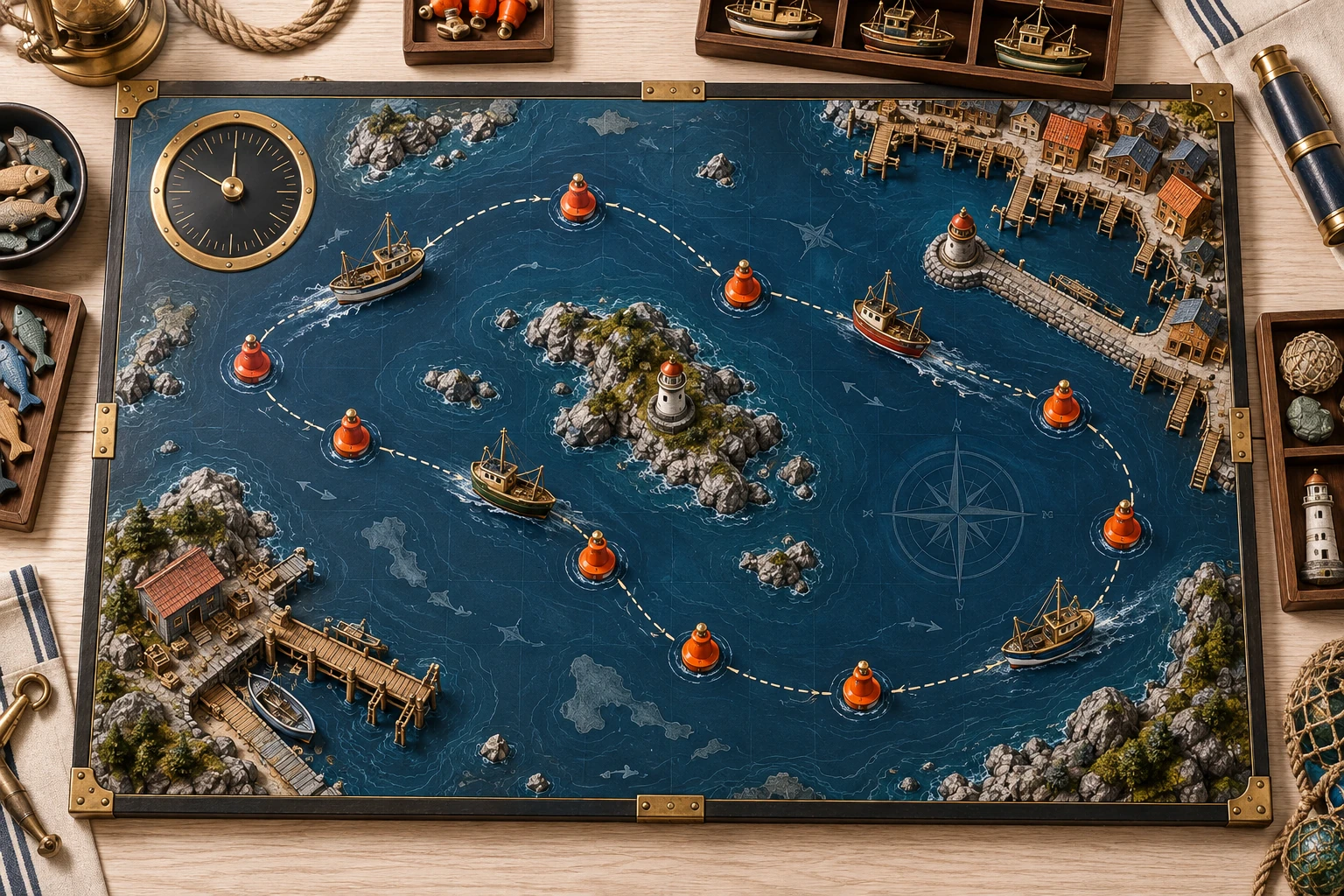
Commit a pace
Choose a legal pace: Drift moves one and restores one fuel; Cruise moves two and costs one; Dash moves three and costs two. You may not spend fuel you do not have.
Read the harbour
Reveal one weather card for your turn. Clear water changes nothing, headwind reduces movement by one to a minimum of one, and tailwind adds one.
Run the line
Pay or restore the pace’s fuel, then move the resulting number of spaces. Stop at buoy twelve if the move would carry you beyond it.
Finish the round
If any boat reaches twelve, finish the current round so each skipper gets the same number of turns. Otherwise begin the next round, up to a maximum of six.
Making the scatter set
Signal cards carry propeller, anchor or pennant scatter marks. Trade one of each for a tune-up token. Before choosing a pace, spend that token to restore two fuel, up to eight. A tune-up never moves the boat by itself.
What decides the result?
At the end of the final round, the furthest boat wins. If boats share that position, the one with more fuel wins the comparison. Matching position and fuel means a shared finish; no extra sudden-death roll is needed.
After the first session
Learn with pace and weather alone. In the expanded regatta, draw one optional pilot, propeller or signal card the first time you cross checkpoint four or eight. Hold at most two, use at most one before choosing a pace, and discard it after its effect. The Copperwake Catch objective is a separate precision variant; agree to its tie-break rule before racing.
Brasswake Regatta turns a Big Bass Bonanza-inspired harbour into a tabletop pace race. Each skipper has the same three movement choices and an eight-unit fuel tank. The drama comes from committing to a speed before the weather is known.
See the illustrated card guide